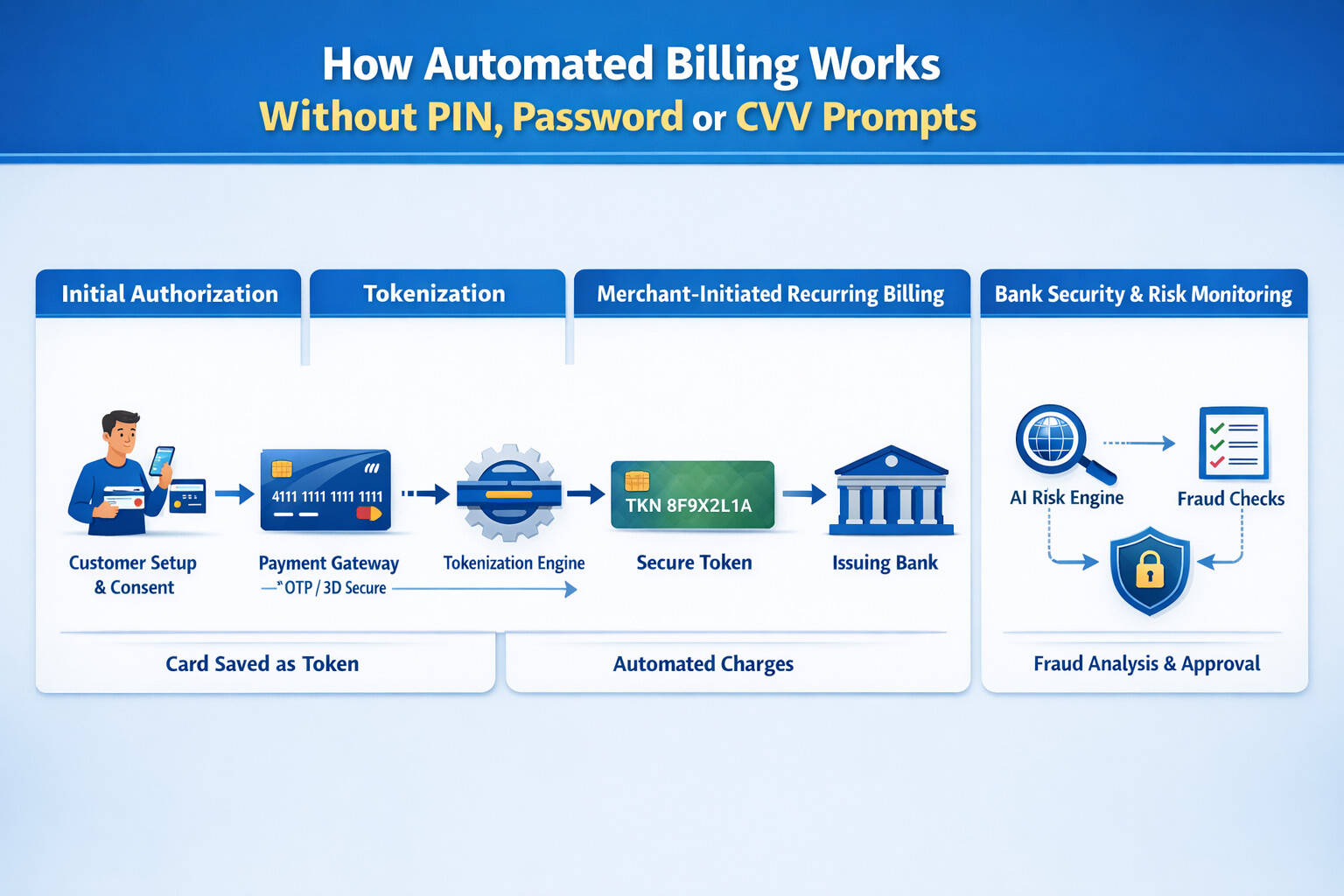
How Automated Billing Works Without PIN, Password, or CVV Prompts
(With Technical Concept Illustrations)
Modern digital services rely on frictionless payments. Whether you’re paying for cloud hosting, streaming services, or SaaS platforms, recurring charges happen automatically—without asking for your PIN, password, or CVV every time.
This article explains how automated billing works technically, why it’s secure, and includes illustrations to simplify the concepts.
What Is Automated Billing?
Automated billing is a payment model where a customer authorizes future charges once, allowing merchants to bill them automatically at scheduled intervals.
Examples:
- Monthly subscriptions
- Usage-based cloud services
- Insurance premiums
- Utility bills
Key Technical Concepts Behind Frictionless Billing
1. Initial Authorization (One-Time Authentication)
At signup, the user performs strong authentication.
+------------+        +----------------+        +------------+
|  Customer  | -----> | Payment Gateway | -----> |   Bank     |
| (Card/MP)  |  OTP   |  + 3DS / OTP    |        | Authorization
+------------+        +----------------+        +------------+
 PIN / OTP / CVV is entered
Bank confirms customer consent
Merchant is approved for future billing
PIN / OTP / CVV is entered
Bank confirms customer consent
Merchant is approved for future billing
2. Tokenization (Replacing Sensitive Card Data)
Once authorization succeeds, real card details are never stored.
Card Number: 4111 1111 1111 1111
        |
        v
+--------------------+
|  Tokenization Engine |
+--------------------+
        |
        v
Token: TKN_9f8aX21Lm
Why tokenization matters:
- Token ≠ card number
- Cannot be reused elsewhere
- Safe even if breached
3. Secure Token Storage
+-------------------+
| Merchant System   |
|-------------------|
| Token: TKN_9f8aX21|
| Billing Cycle: 30 |
| Amount: Variable  |
+-------------------+
Merchant stores only tokens
PCI-DSS compliance
No CVV or PIN retained
How Recurring Billing Happens Automatically
Merchant-Initiated Transactions (MITs)
Recurring payments are classified as MITs, meaning:
- The merchant initiates the charge
- Customer presence is not required
- Allowed by Visa, Mastercard, and banks
Billing Date Reached
        |
        v
+-------------------+     Token      +-------------------+
| Merchant System   | ------------> | Payment Gateway   |
+-------------------+               +-------------------+
                                          |
                                          v
                                  +-------------------+
                                  | Issuing Bank     |
                                  | (Recognizes MIT) |
                                  +-------------------+
                                          |
                                          v
                                   Payment Approved
No CVV required
No OTP required
No PIN required
Security Controls That Replace Manual Authentication
1. Risk-Based Monitoring
Transaction Data
   |
   v
+-------------------+
| AI Risk Engine    |
|-------------------|
| Amount Check      |
| Frequency Check   |
| Merchant Profile  |
| Location Pattern  |
+-------------------+
If risk is detected → step-up authentication is triggered.
2. Transaction Limits & Rules
Banks enforce:
- Maximum charge amount
- Billing frequency
- Merchant restrictions
IF Amount > Expected Range
OR Merchant Changes
OR Unusual Pattern
THEN → Require OTP
3. Customer Control & Revocation
Customers can:
- Cancel subscriptions
- Disable auto-pay
- Block tokens instantly
Customer App / Portal
        |
        v
[ Disable Token ]
        |
        v
Future Charges Blocked
Why CVV Is Not Needed Again
| Factor | Reason |
|---|---|
| CVV | Used only to verify first possession |
| Token | Proves ongoing authorization |
| MIT Flag | Tells bank this is pre-approved |
| Risk Engine | Monitors continuously |
Result: Strong security without repeated friction.
Real-World Use Case Illustration
Example: Cloud Hosting Subscription
Month 1:  OTP + CVV + Token Created
Month 2:  Token → Auto Charge
Month 3:  Token → Auto Charge
Month 4:  Token → Auto Charge
No failed payments
Predictable revenue
Seamless user experience
Regulatory Compliance
Automated billing complies with:
- PCI-DSS – Card data protection
- PSD2 SCA Exemptions – Recurring payments
- Visa & Mastercard MIT Rules
- Local Central Bank Regulations (including Kenya)
Benefits of This Billing Model
For Customers
- No repetitive authentication
- Faster transactions
- Fewer failed payments
For Businesses
- Higher retention
- Stable cash flow
- Reduced payment friction
- Lower support costs
When Re-Authentication Happens
Even automated systems may request verification if:
- Amount changes significantly
- Billing frequency changes
- Risk is detected
- Regulatory audits apply
This ensures trust without sacrificing convenience.
Final Thoughts
Automated billing without PIN, password, or CVV works because of:
- One-time trust establishment
- Secure tokenization
- Merchant-initiated transaction rules
- Intelligent risk monitoring
It is not weaker than manual authentication—in most cases, it is more secure and more reliable.