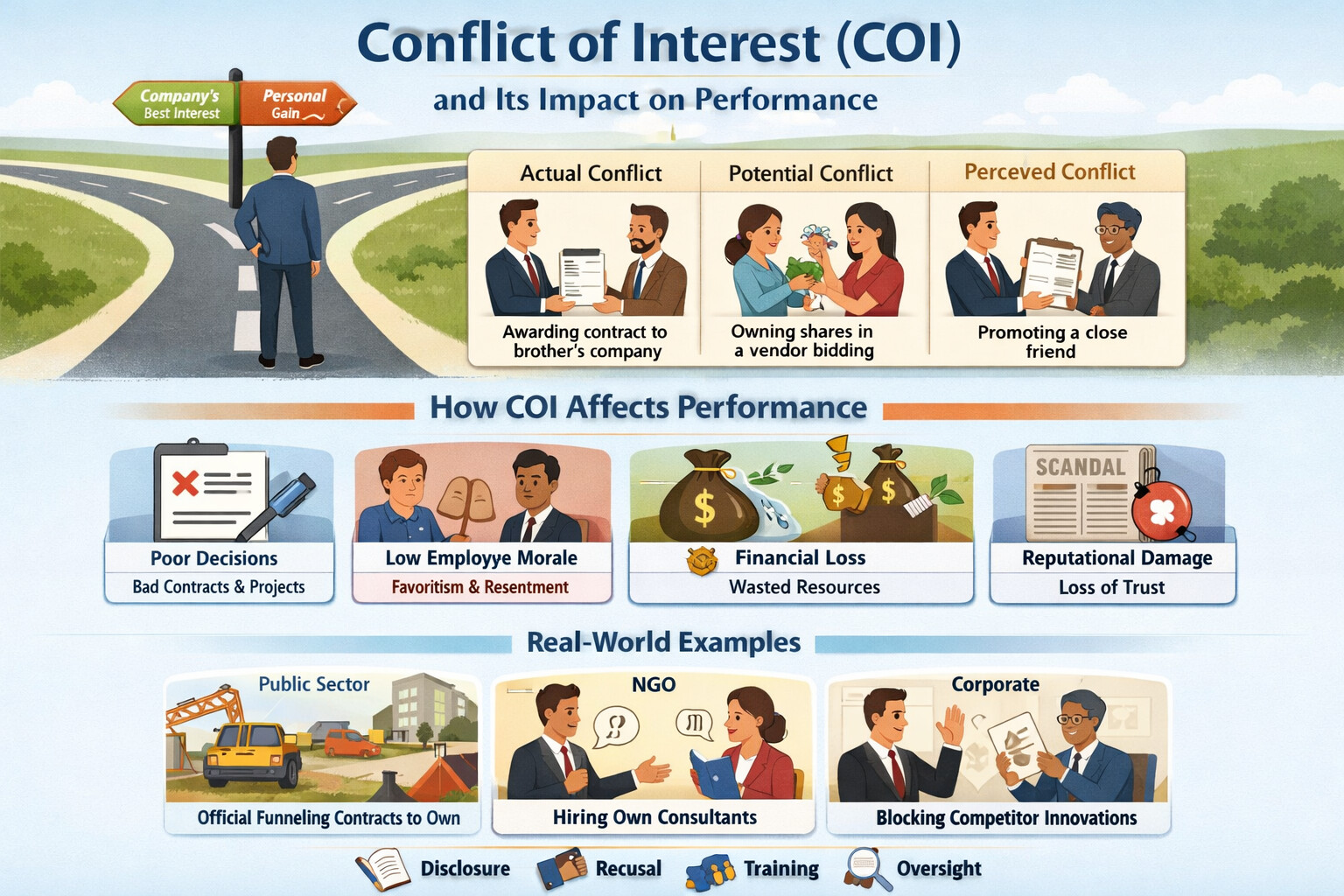
Conflict of Interest (COI): Meaning, Examples, and How It Affects Performance
Introduction
Every organization, whether a government office, NGO, school, or private company, runs on trust. Trust that decisions are fair. Trust that resources are used wisely. Trust that leaders act in the best interest of the institution, not themselves.
A Conflict of Interest (COI) quietly erodes this trust.
Unlike fraud or corruption, a conflict of interest does not always involve illegal action. It often begins as a situation, not an act. But when unmanaged, it can grow into poor performance, damaged reputation, financial loss, and even legal trouble.
This article explores what conflict of interest means, its types, real-life illustrations, and how it directly affects organizational performance.
What Is Conflict of Interest?
A Conflict of Interest occurs when an individual’s personal, financial, or relational interests interfere, or appear to interfere, with their professional duties and decision-making.
In simple terms:
You are expected to act for the organization, but something personal pulls you in another direction.
The key issue is divided loyalty.
Simple Illustration
Imagine a forked road:
- One path leads to what is best for the organization
- The other leads to personal gain
A conflict of interest is standing at that fork while pretending there is only one road.
Even if you choose correctly, the appearance of bias can still damage trust.
Types of Conflict of Interest
1. Actual Conflict of Interest
This exists when personal interests directly influence professional decisions.
Example: A procurement officer awards a contract to a company owned by their sibling.
Here, the personal relationship has already affected the decision.
2. Potential Conflict of Interest
This exists when personal interests could influence decisions in the future.
Example: A board member owns shares in a supplier that is about to bid for a contract.
Nothing wrong has happened yet, but the risk is present.
3. Perceived (Apparent) Conflict of Interest
This exists when others reasonably believe a conflict exists, even if it does not.
Example: A school principal promotes a teacher who happens to be a close friend, despite qualifications being equal.
Even if the promotion is fair, the perception damages credibility.
Common Areas Where COI Occurs
Employment and Hiring
- Hiring relatives or close friends without transparency
- Influencing promotions for personal loyalty rather than merit
Procurement and Contracts
- Favoring certain suppliers
- Receiving gifts or kickbacks from vendors
Financial Interests
- Owning businesses that benefit from organizational decisions
- Using insider information for personal investment
Governance and Leadership
- Board members voting on matters where they have personal stakes
- Executives sitting on multiple boards with competing interests
How Conflict of Interest Affects Performance
1. Poor Decision-Making
When personal interests override objective analysis, decisions become biased.
Impact:
- Substandard suppliers selected
- Inefficient projects approved
- Better alternatives ignored
Over time, this leads to operational failure.
2. Reduced Employee Morale
Employees quickly notice favoritism.
Illustration: Two staff members work equally hard. One is promoted because of connections, not performance.
Result:
- Demotivation
- Reduced productivity
- Increased staff turnover
A workplace perceived as unfair cannot perform at its best.
3. Financial Loss
COI often leads to:
- Overpriced contracts
- Low-quality goods and services
- Repeated project failures
Money leaks slowly, like a cracked pipe, often unnoticed until the damage is severe.
4. Reputational Damage
Trust is fragile.
Once stakeholders believe decisions are biased:
- Customers lose confidence
- Donors withdraw funding
- Partners hesitate to collaborate
Rebuilding reputation costs far more than preventing COI.
5. Legal and Compliance Risks
Unmanaged conflicts can violate:
- Procurement laws
- Corporate governance rules
- Ethical codes
This exposes organizations to:
- Lawsuits
- Fines
- Leadership removal
Real-World Style Examples
Example 1: Public Sector
A county official oversees road construction tenders while secretly owning a construction firm.
Outcome:
- Inflated project costs
- Poor road quality
- Public outrage and investigations
Performance drops while accountability increases.
Example 2: NGO or Donor-Funded Project
A project manager hires consultants from their own private firm.
Outcome:
- Biased evaluation reports
- Donor mistrust
- Funding suspension
Even if work is done, credibility is lost.
Example 3: Corporate Environment
A senior manager blocks innovative proposals because they threaten a product they personally invested in.
Outcome:
- Stagnation
- Loss of market competitiveness
- Talent exits to more transparent firms
Why Conflict of Interest Is Hard to Detect
- It often hides behind “normal” relationships
- People justify actions as harmless
- Disclosure is avoided out of fear or embarrassment
This makes strong systems essential.
Managing and Preventing Conflict of Interest
1. Clear COI Policies
Organizations must clearly define:
- What constitutes a conflict
- What must be disclosed
- Consequences of non-disclosure
2. Mandatory Disclosure
Regular declarations of:
- Financial interests
- Relationships
- External roles
Disclosure does not mean wrongdoing. It means transparency.
3. Recusal from Decision-Making
If you have an interest:
- Step out of discussions
- Avoid voting
- Allow independent review
This protects both the individual and the organization.
4. Training and Awareness
Many conflicts arise from ignorance, not malice.
Training helps staff:
- Recognize conflicts early
- Act ethically
- Ask for guidance without fear
5. Independent Oversight
Audit committees, ethics boards, and external reviews reduce bias and strengthen accountability.
Final Thoughts
Conflict of interest is not always about bad people. Often, it is about good people placed in risky situations without guardrails.
When unmanaged, COI quietly undermines performance, fairness, and trust. When addressed openly, it strengthens governance and decision-making.
The strongest organizations are not those without conflicts, but those that identify, disclose, and manage them transparently.
Integrity, like performance, is built through consistent choices, even when no one is watching.