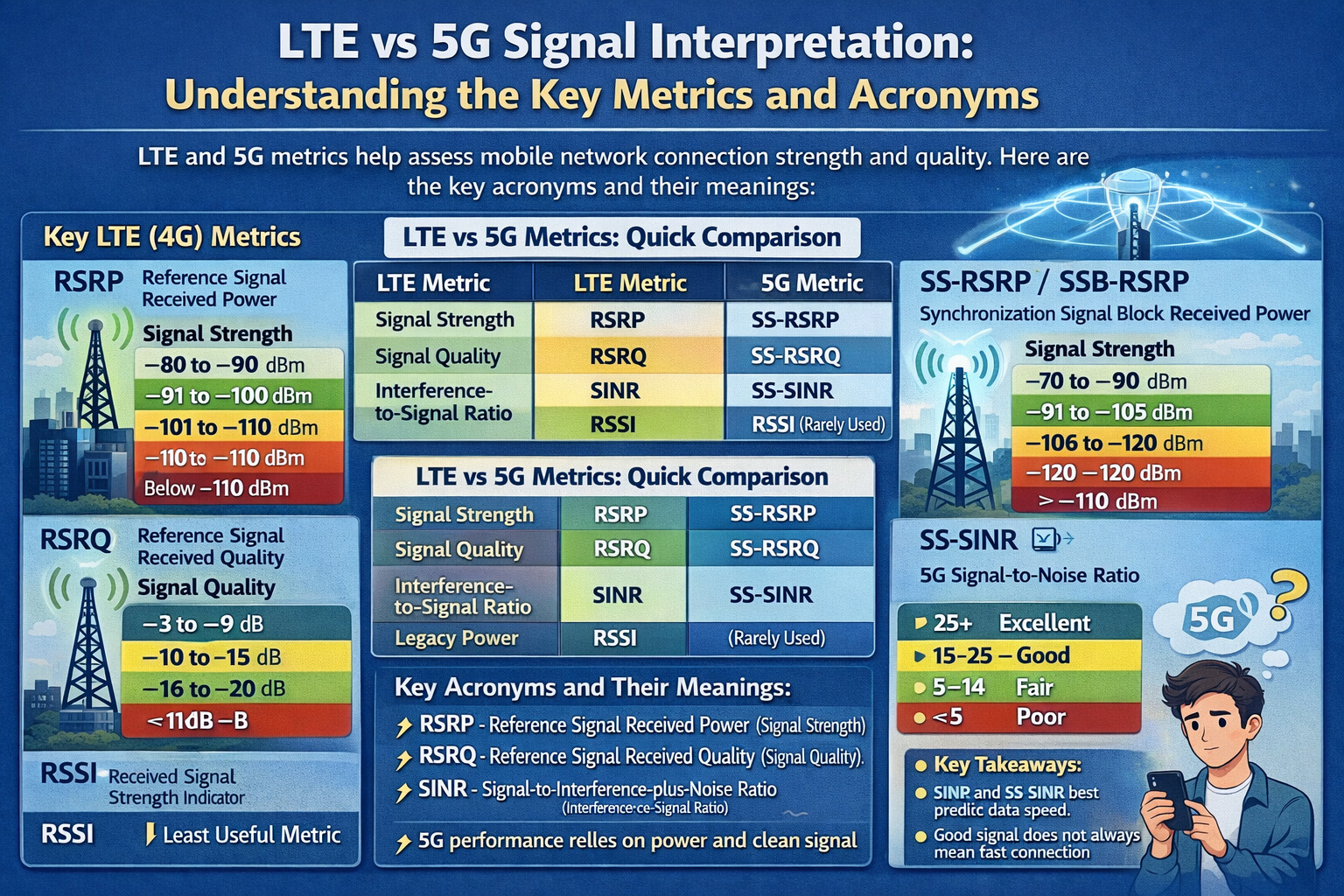
LTE vs 5G Signal Interpretation: Understanding the Key Metrics and Acronyms
As mobile networks evolve from LTE (4G) to 5G (NR), signal indicators have become more detailed—and more confusing. Users now see acronyms such as RSRP, RSRQ, SINR, RSSI, SSB-RSRP, and others.
This article explains:
- How LTE and 5G signal metrics differ
- What each acronym means
- Which values matter most
- How to interpret “good” vs “bad” readings in real-world usage
1. Why Signal Interpretation Is Different in LTE and 5G
In older networks (2G/3G), RSSI alone was enough to estimate signal strength.
Modern networks:
- Use multiple antennas
- Use beamforming
- Separate signal strength from signal quality
As a result:
- A strong signal does not always mean good performance
- Quality metrics (interference, noise) matter as much as power
2. Core LTE Signal Metrics (4G)
2.1 RSRP – Reference Signal Received Power
What it measures: The power of LTE reference signals from the serving cell.
Unit: dBm Primary indicator of signal strength
Typical values:
| RSRP (dBm) | Quality |
|---|---|
| –80 to –90 | Excellent |
| –91 to –100 | Good |
| –101 to –110 | Fair |
| < –110 | Poor |
Key point: RSRP is the most important LTE signal strength metric.
2.2 RSRQ – Reference Signal Received Quality
What it measures: Signal quality, factoring in interference and load.
Unit: dB Indicates congestion and interference
Typical values:
| RSRQ (dB) | Quality |
|---|---|
| –3 to –9 | Excellent |
| –10 to –15 | Good |
| –16 to –20 | Poor |
Key point: A strong RSRP with poor RSRQ usually means cell congestion.
2.3 SINR – Signal-to-Interference-plus-Noise Ratio
What it measures: How clean the signal is compared to interference and noise.
Unit: dB Directly affects speed and stability
Typical values:
| SINR (dB) | Quality |
|---|---|
| 20+ | Excellent |
| 13–20 | Good |
| 0–12 | Fair |
| < 0 | Poor |
Key point: SINR is the best predictor of LTE data speed.
2.4 RSSI – Received Signal Strength Indicator
What it measures: Total received power (signal + noise + interference).
Unit: dBm Least useful metric
Why it matters less: RSSI can look strong even when performance is poor.
3. Core 5G Signal Metrics (NR)
5G introduces beam-based measurements and separates LTE-style metrics from NR-specific ones.
3.1 SS-RSRP / SSB-RSRP – Synchronization Signal Block RSRP
What it measures: Signal power of 5G synchronization blocks.
Unit: dBm Equivalent of LTE RSRP in 5G
Typical values:
| SS-RSRP (dBm) | Quality |
|---|---|
| –70 to –90 | Excellent |
| –91 to –105 | Good |
| –106 to –120 | Fair |
| < –120 | Poor |
3.2 SS-RSRQ – Synchronization Signal Quality
What it measures: Quality of the 5G reference signal.
Unit: dB Similar purpose to LTE RSRQ
Typical values:
| SS-RSRQ (dB) | Quality |
|---|---|
| –5 to –10 | Excellent |
| –11 to –15 | Good |
| –16+ | Poor |
3.3 SS-SINR – 5G Signal-to-Noise Ratio
What it measures: Signal clarity and beam effectiveness.
Unit: dB Critical for high 5G throughput
Typical values:
| SS-SINR (dB) | Quality |
|---|---|
| 25+ | Excellent |
| 15–25 | Good |
| 5–14 | Fair |
| < 5 | Poor |
4. LTE vs 5G Metrics Comparison
| Concept | LTE Metric | 5G Metric |
|---|---|---|
| Signal strength | RSRP | SS-RSRP |
| Signal quality | RSRQ | SS-RSRQ |
| Interference ratio | SINR | SS-SINR |
| Legacy power | RSSI | (Rarely used) |
5. Why 5G Can Feel Slow Despite “Strong Signal”
Common causes:
- NSA mode (5G anchored on LTE)
- Poor SINR despite good RSRP
- Beam misalignment
- High-frequency bands (mmWave) blocked by walls
- Network slicing or congestion
In 5G:
Quality and beam alignment matter more than raw power
6. Which Metrics Matter Most?
For LTE:
- SINR
- RSRP
- RSRQ
For 5G:
- SS-SINR
- SS-RSRP
- SS-RSRQ
7. Practical Example
LTE Reading:
- RSRP: –81 dBm (Good)
- RSRQ: –16 dB (Poor)
- SINR: 4 dB (Low)
Result: Good signal strength but slow speeds due to congestion/interference.
5G Reading:
- SS-RSRP: –85 dBm (Good)
- SS-SINR: 28 dB (Excellent)
Result: High throughput and stable performance.
8. Final Takeaways
- Negative values are normal in RF measurements
- Signal strength ≠ performance
- SINR is the most reliable speed indicator
- 5G introduces beam-based complexity
- Good 5G requires both power and clean signal paths