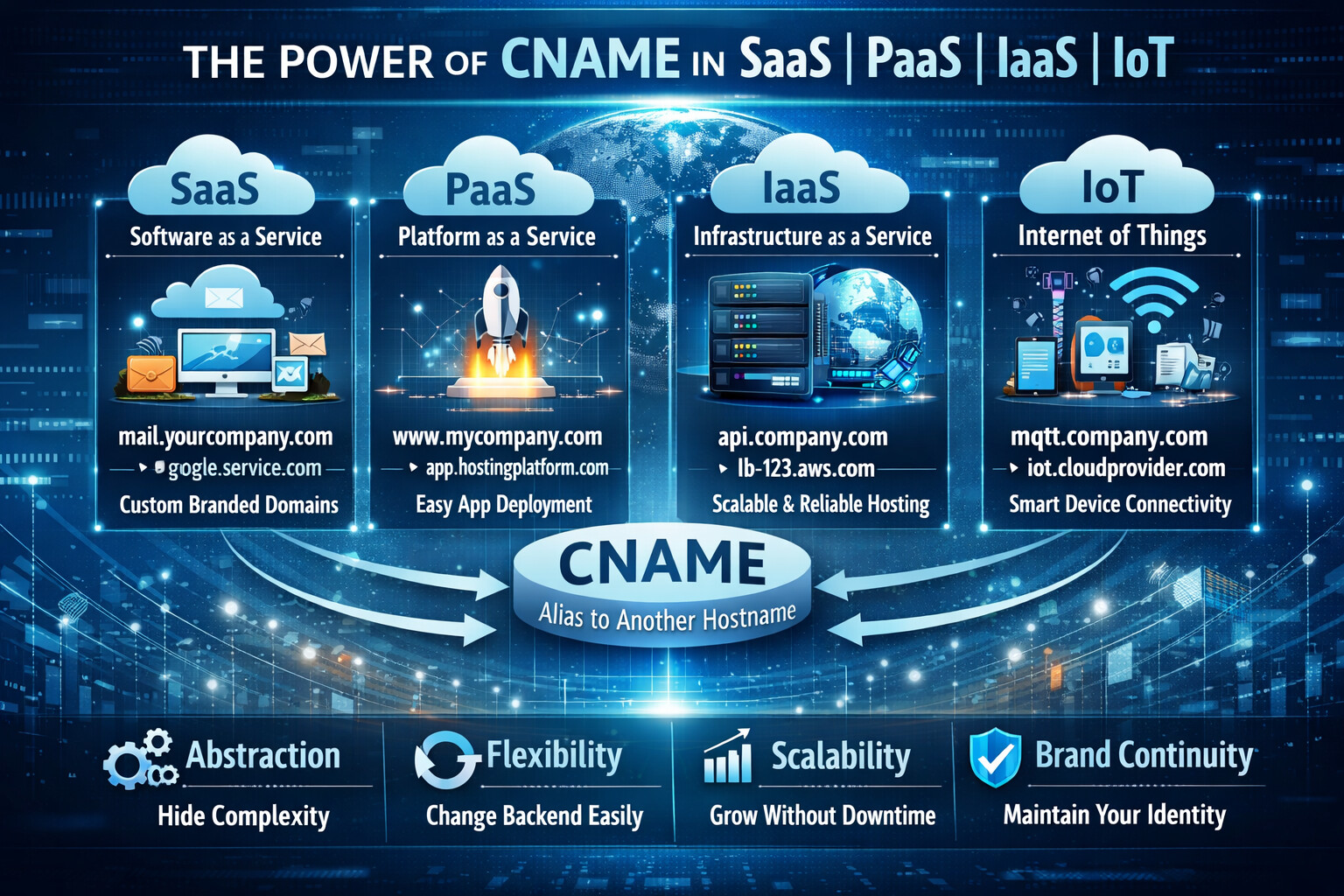
The Power of CNAME Across SaaS, PaaS, IaaS, and IoT 

In the quiet machinery of the internet, the CNAME record works like a skilled stage manager. You rarely see it, yet it ensures the show runs smoothly. From cloud software to connected sensors, CNAMEs quietly stitch brands, platforms, and devices into a seamless experience.
Let’s explore how this single DNS record flexes its muscles across SaaS, PaaS, IaaS, and IoT.
First, what is a CNAME?
A CNAME (Canonical Name) record lets one domain name act as an alias for another.
Instead of pointing directly to an IP address, it points to another hostname.
Example idea:
app.company.com→provider.platform.com
If the provider changes infrastructure, the alias stays calm and unchanged. Stability without rigidity. That’s the magic.
1. CNAME in SaaS (Software as a Service) 

SaaS thrives on branding and trust.
Users want:
- Familiar URLs
- Seamless access
- Zero awareness of backend changes
How CNAME powers SaaS
CNAME enables custom domains.
Examples:
mail.yourcompany.com→ Google Workspacesupport.nestict.com→ Zendeskportal.company.com→ Invoice Ninja, ERP, CRM tools
Why it matters
- Strong brand identity
- Easier user adoption
- Providers can move servers without breaking links
CNAME acts like a mask that keeps the provider invisible while your brand stays front and center.
2. CNAME in PaaS (Platform as a Service) 

PaaS is all about developers moving fast without managing infrastructure.
Platforms like:
- Heroku
- Vercel
- Netlify
- Render
How CNAME powers PaaS
Your app gets a temporary platform URL:
myapp.herokuapp.com
You then map:
www.mycompany.com→myapp.herokuapp.comvia CNAME
Why it matters
- One app, many environments (dev, staging, production)
- Easy migrations between regions
- Blue-green deployments without DNS chaos
CNAME lets platforms evolve underneath while developers keep shipping features on top.
3. CNAME in IaaS (Infrastructure as a Service) 

IaaS lives in a world of change. IPs shift. Servers scale. Regions fail and recover.
How CNAME powers IaaS
Instead of pointing domains directly to IPs, you point them to service endpoints.
Examples:
storage.company.com→bucket.s3.amazonaws.comapi.company.com→lb-123.aws.amazon.com
Why it matters
- Load balancers can change IPs freely
- High availability and failover
- Safer scaling without downtime
CNAME gives infrastructure the freedom to breathe, stretch, and heal.
4. CNAME in IoT (Internet of Things) 

IoT is where things talk, listen, and report. Millions of devices depend on predictable endpoints.
How CNAME powers IoT
Devices connect to logical names, not fixed IPs.
Examples:
mqtt.company.com→iot.cloudprovider.comtelemetry.company.com→ regional ingestion endpoint
Why it matters
- Devices don’t need firmware updates when servers move
- Regional routing without reconfiguration
- Smooth transition between cloud vendors
In IoT, CNAME is the difference between silent devices and a living network.
The Big Picture 
Across all four domains, CNAME delivers the same superpowers:
- Abstraction: hide complexity
- Flexibility: change backend without breaking users
- Scalability: grow without DNS rewrites
- Brand continuity: your name, their engine
Think of CNAME as a DNS lever. Pull it once, and entire platforms shift without the audience noticing.
Final Thought 
SaaS sells convenience. PaaS sells speed. IaaS sells power. IoT sells connection.
CNAME sells continuity.
It is small, simple, and quietly essential. In a cloud-shaped world that never stops moving, CNAME is how everything keeps its balance.