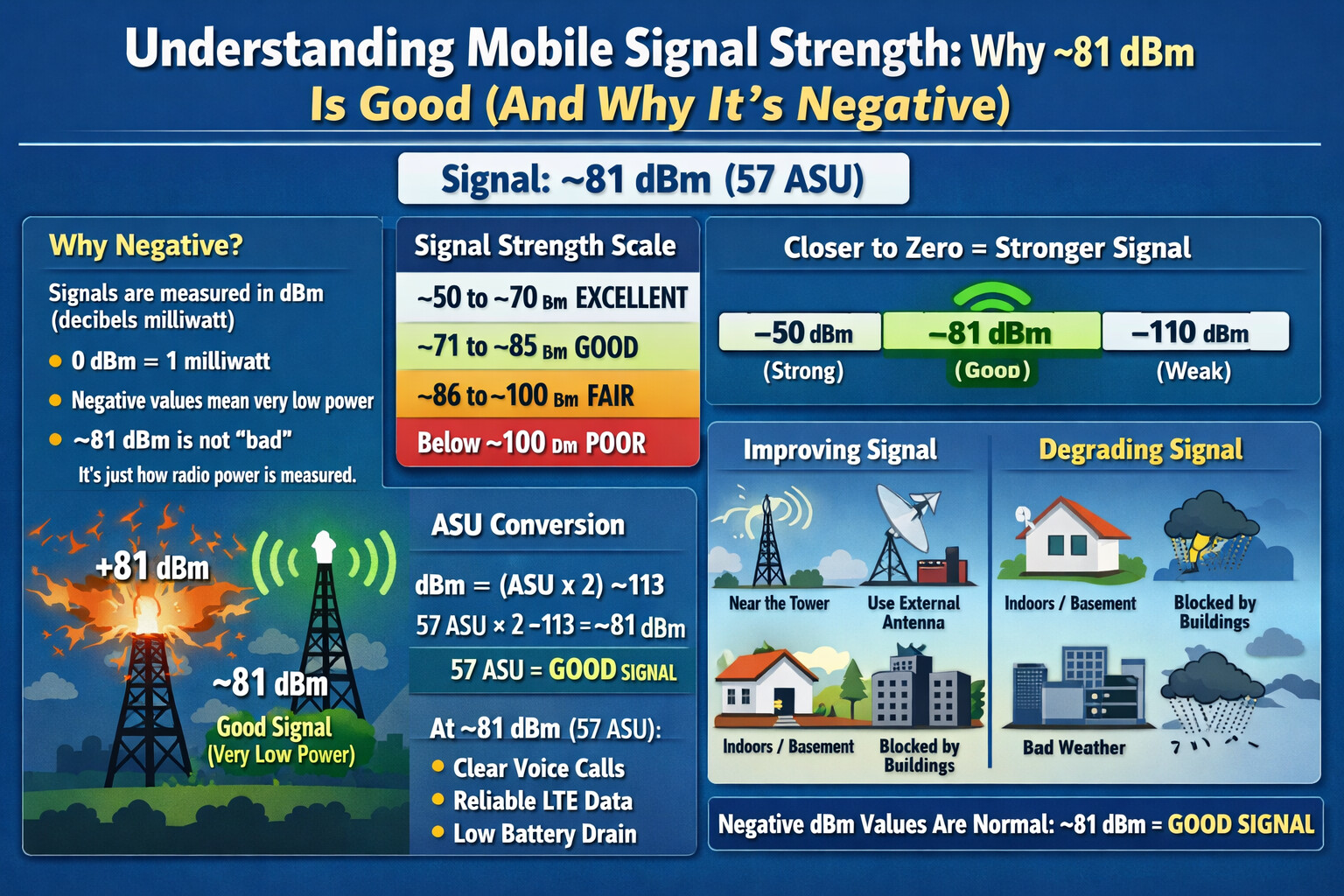
Understanding Mobile Signal Strength: Why –81 dBm Is Good (and Why It’s Negative)
When checking mobile network diagnostics on a phone, LTE router, or modem, you may encounter signal readings such as:
Signal strength: –81 dBm (57 ASU)
At first glance, this can be confusing—especially the negative number. Why is the signal shown as –81 and not +81? And what does it mean when the number increases or decreases?
This article breaks it down in practical, non-abstract terms.
1. What Is dBm?
dBm stands for decibels relative to one milliwatt. It is a logarithmic unit used to measure received radio signal power.
Key points:
- It is an absolute measurement, not a percentage
- It is measured relative to 1 milliwatt (mW)
- In wireless communications, received signals are almost always below 1 mW
Because of this, the resulting values are negative.
2. Why Signal Strength Is Negative (–81 dBm)
A signal strength of –81 dBm means:
The received signal power is much weaker than 1 milliwatt
In fact:
- 0 dBm = 1 milliwatt
- –30 dBm = 0.001 milliwatt
- –60 dBm = 0.000001 milliwatt
- –81 dBm = extremely small power, but still very usable
Why not +81 dBm?
A signal of +81 dBm would represent:
- Over 12,000 watts
- Far stronger than radio towers themselves
- Physically impossible for a mobile device to receive
So:
- Negative does not mean bad
- It simply reflects how radio power is measured
3. Understanding “Increasing” vs “Decreasing” Signal Strength
This is where most confusion happens.
In dBm:
- –60 dBm is stronger than –81 dBm
- –90 dBm is weaker than –81 dBm
Even though –90 looks like a “bigger” number, it is worse.
Rule of thumb:
Closer to zero = stronger signal
4. Signal Strength Quality Scale (dBm)
| Signal (dBm) | Quality | Real-World Experience |
|---|---|---|
| –50 to –70 | Excellent | Fast data, stable calls |
| –71 to –85 | Good | Normal performance |
| –86 to –100 | Fair | Slower data, some drops |
| Below –100 | Poor | Unreliable connection |
Your value:
–81 dBm → Good signal
5. What Is ASU and Why 57 ASU Matches –81 dBm
ASU (Arbitrary Strength Unit) is a device-friendly representation of signal strength.
For LTE (4G) networks, the conversion is typically:
dBm = (ASU × 2) − 113
Using your reading:
(57 × 2) − 113 = –81 dBm
This confirms:
- The modem/phone is reporting consistently
- The signal is genuinely in the good range
6. Does Increasing ASU Improve Signal?
Yes—but only if it results in less negative dBm.
Examples:
| ASU | dBm | Result |
|---|---|---|
| 45 | –23 dBm | Extremely strong (rare) |
| 57 | –81 dBm | Good |
| 65 | –83 dBm | Slightly weaker |
| 30 | –53 dBm | Excellent |
So:
- Higher ASU usually means better signal
- But the real authority is dBm
7. What Causes Signal to Improve or Degrade?
Signal Improves When:
- You move closer to the cell tower
- You install an external LTE antenna
- Line-of-sight obstruction is reduced
- Network load is low
Signal Degrades When:
- You move indoors or underground
- Buildings, metal, or terrain block RF paths
- Weather conditions affect propagation
- The tower is congested or distant
8. Practical Impact of –81 dBm
At –81 dBm, you can expect:
- Stable voice calls
- Reliable LTE data
- Usable hotspot/tethering
- Minimal battery drain from signal searching
Slow speeds at this level are usually due to congestion, not signal strength.
9. Final Takeaway
- Negative dBm values are normal
- –81 dBm is good, not weak
- Signal quality improves as the number moves closer to zero
- ASU is just another way of expressing the same information
- Good signal does not always equal fast internet—network load matters